What happens when clinical research meets real-world patient care?
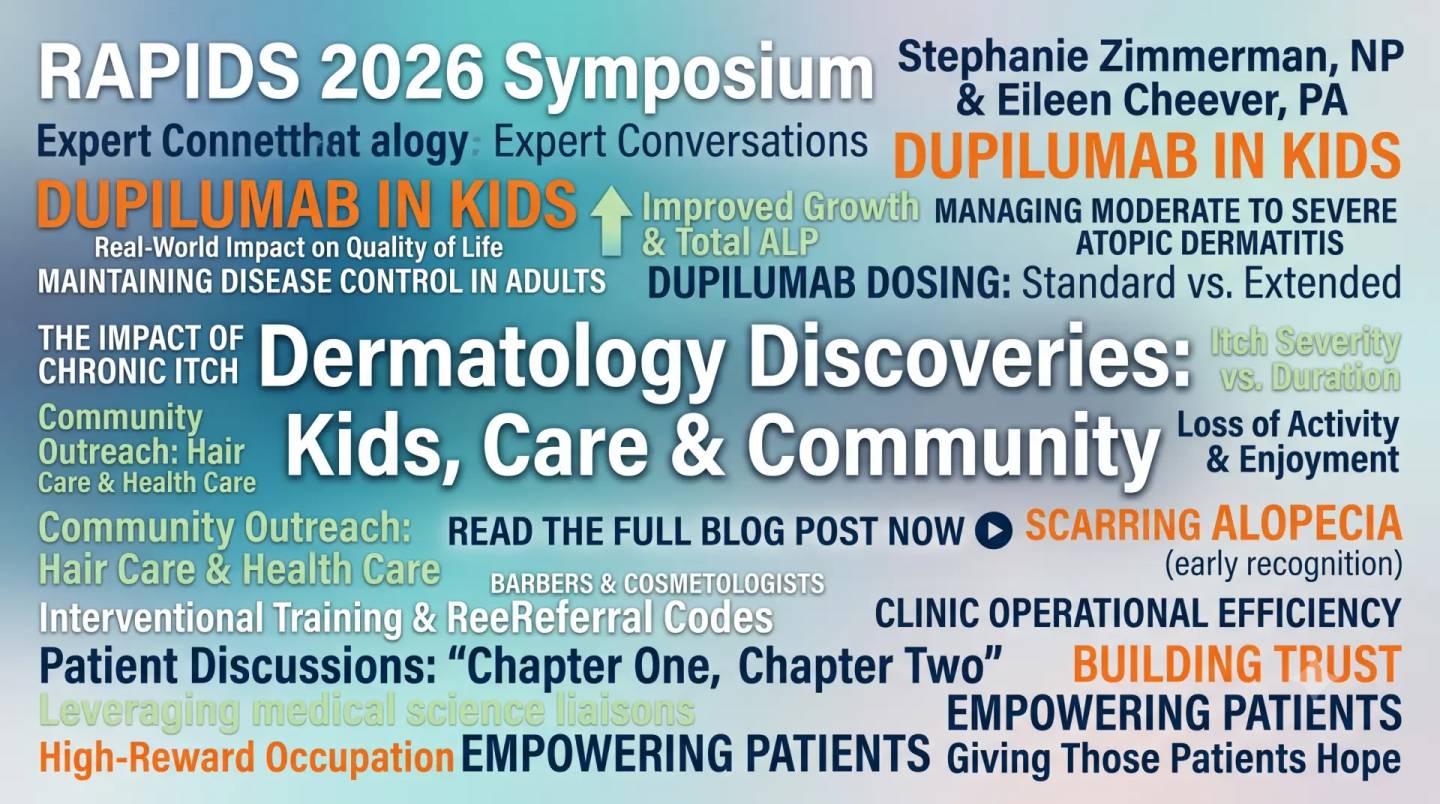
At the Rapids 2026 conference in Fort Lauderdale, dermatology PA Eileen Cheever sat down with dermatology nurse practitioner Stephanie Zimmerman to break down the most impactful lectures and abstracts from the symposium. From groundbreaking pediatric data to the psychology of chronic itch and navigating clinic bottlenecks, their conversation provided a masterclass in high-reward dermatology.
If you missed the live sessions, here are the four major takeaways that every clinician and patient should know.
1. Biologics & Pediatric Growth: A Sigh of Relief for Parents
One of the most talked-about abstracts at the symposium focused on the use of dupilumab in young children (ages 2 to 5) suffering from moderate to severe atopic dermatitis.
Historically, parents have faced immense anxiety when starting a systemic biologic. However, under-treating severe eczema in children carries its own severe risks—including a failure to thrive and stunted growth due to chronic inflammation and sleep deprivation.
The Key Takeaway:
By measuring serum biomarkers, specifically total alkaline phosphatase (ALP), researchers found that patients treated with dupilumab showed an increase in total ALP at 16 weeks. This biochemically correlated with a significant improvement in their growth and development on standard growth charts over just a 16-week period.
Note: The abstract did note that boys showed a slightly higher increase in growth than girls, marking an exciting knowledge gap for future studies to explore.
Why it matters: This data gives clinicians the tools to help parents overcome the "needle phobia" and anxiety of initiating a biologic. It proves that the treatment isn't just clearing skin; it's unlocking a child's natural growth potential.
2. The Million-Dollar Question: "When Can I Stop My Medication?"
Every clinician hears it: as soon as an adult patient feels better, they immediately want to know when they can stop taking their medication. A real-world abstract presented by Zimmerman tackled this head-on, examining how to maintain minimal disease control in adults receiving Dupilumab.
The study randomized adult patients who had achieved stability and tested different dosing schedules:
- The standard dose (every 2 weeks)
- Extended intervals (every 4 weeks)
- Extended intervals (every 8 weeks)
- Placebo
The Results:
Patients who spaced out their doses to every 2 to 4 weeks still maintained an incredibly high level of disease control and a significant quality of life.
While every provider has a different threshold for stability before they "tinker" with dosing (ranging from 6 months to 2 years), this data shows that safely spacing out doses can give patients the freedom they crave while keeping their itch completely at bay.
3. The Compounding Burden of Chronic Itch
An insightful study from UT Health in San Antonio examined patient-reported outcomes for chronic itch. The researchers stratified adult patients by duration of suffering: less than 12 weeks, 13 to 54 weeks, or greater than 54 weeks.
Interestingly, the perceived severity of the pain from the itch was similar across all groups. However, the longer a patient had suffered from the chronic itch, the more it interfered with their enjoyment of daily activities.
| Duration of Itch | Clinical Phase | Patient Mindset | Daily Life Impact |
|---|---|---|---|
| < 12 Weeks | Short-Term | Optimistic Working with a provider toward a solution. | Low Disruption Manageable burden on daily activities. |
| 13 – 54 Weeks | Mid-Term | Frustrated Standard topical treatments begin to fail. | Moderate Burden Anxiety and sleep disruption begin to peak. |
| > 54 Weeks | Long-Term | Hopeless Feeling trapped by the condition. | Severe Disruption Social withdrawal and loss of enjoyment in life. |
"When they come back for their follow-up, and the itch is gone, they are a completely different person. Their shoulders drop... that is why what we do is so high-reward." — Stephanie Zimmerman, NP
4. Grassroots Dermatology: The "Hair Care & Health Care" Study
In a wonderful twist of fate, the author of a remarkable community outreach abstract was sitting anonymously in the audience while Zimmerman presented her data!
The study, conducted independently by an aspiring NP named Miriam, focused on early intervention for scarring alopecia—a condition that is notoriously diagnosed too late to reverse.
- The Method: Miriam conducted a 40-minute educational training session for barbers and cosmetology students in the African American community, using a pre- and post-test model to measure their recognition of signs of scarring alopecia.
- The Outcome: The brief training dramatically improved early recognition and sparked a successful referral pipeline via QR codes.
The presentation evolved into an inspiring group discussion about how community outreach models like this could be expanded to address other underdiagnosed conditions, such as Hidradenitis Suppurativa (HS).
Mastering Clinic Efficiency: Tackling the Bottlenecks
To wrap up, Zimmerman shared a sneak peek of her lecture on operational efficiency. For newer grads or clinics transitioning into complex inflammatory diseases, moving a patient from the initial decision to actually starting a systemic therapy can feel like an administrative nightmare.
How do you beat the bottleneck? Zimmerman recommends a multi-step approach:
1. View Care as Chapters
Don't try to cram disease education, drug selection, insurance access paperwork, and lab orders into a single visit. "Treat it like a book," Stephanie advises. "This visit is Chapter One. The next visit is Chapter Two." Spacing out the information prevents patient overwhelm and streamlines clinic flow.
2. "Phone a Friend" & Utilize MSLs
If you are a solo practitioner or your collaborative physician doesn’t specialize in systemics, don't practice in fear. Build relationships with Medical Science Liaisons (MSLs) and establish a "phone-a-friend" network with regional experts for second opinions.
3. Delegate to Elevate
Empower your medical assistants and nursing staff to handle the heavy lifting of intake and administrative follow-up. If you try to do it all yourself, you limit the number of lives you can impact.
The Ultimate Goal of the First Visit
When a frustrated, hopeless patient walks into your clinic, your primary job in that first visit is to drop their anxiety.
"I want them to walk away feeling empowered," says Zimmerman. "We might not choose the exact drug on day one, but when they see that we have an entire armamentarium of safe, effective, clean medications—and that we see them, not just their disease—their shoulders visibly drop. The anxiety diffuses. That is how you build a relationship for long-term success."
Listen to the entire podcast on Apple Podcasts or Spotify